


India’s Infra Push: Opportunity Zones in Tier-2/3 Cities
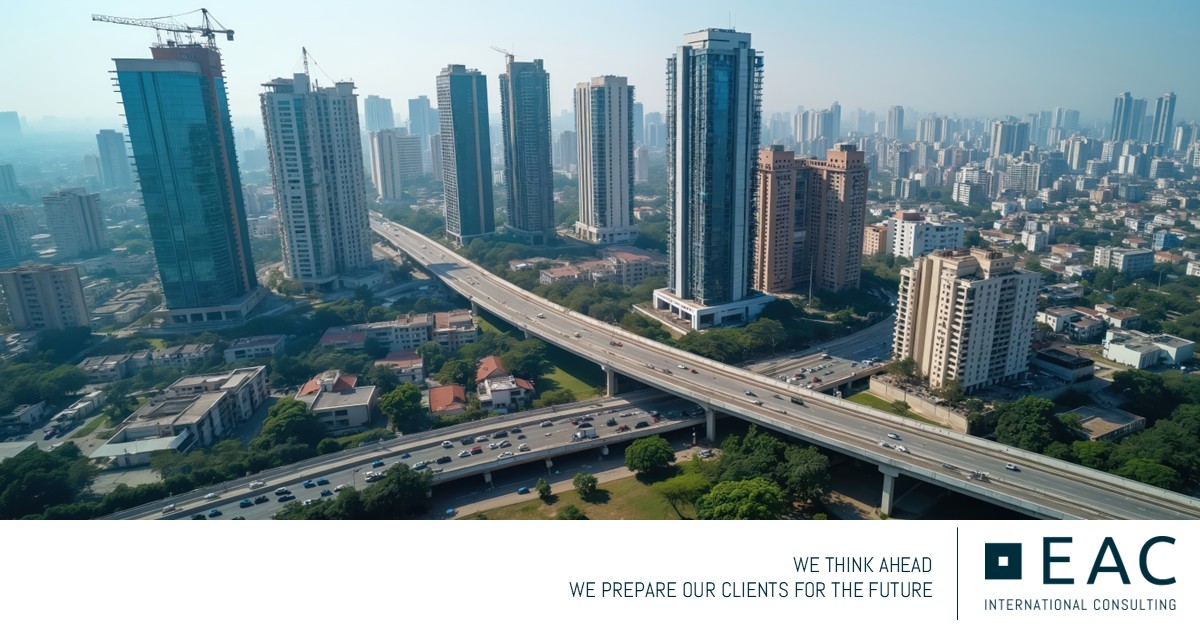
Indian government has earmarked over 130.1 billion EUR toward urban infrastructure upgrades in non-metro cities through flagship programs such as the PM Gati Shakti Master Plan, Smart Cities Mission, UDAN Scheme, and AMRUT 2.0. These initiatives are upgrading core urban infrastructure, metro rail, water and sanitation systems, digital governance platforms, industrial parks, and logistics hubs, in emerging cities like Surat, Indore, Vizag, Kochi, Bhubaneswar, and Lucknow. This urban push is accelerating demand for building materials across residential, commercial, civic, and industrial construction segments.
India’s infrastructure push is increasingly shaped by green, climate-conscious mandates, with cities now focusing on energy-efficient buildings, sustainable urban planning, and low-carbon construction materials. This shift is creating real demand for innovative solutions such as insulation systems, drywall, green concrete, high-performance glass, water-saving fixtures, and recycled materials that align with national sustainability goals. Government-backed green rating systems such as GRIHA, IGBC, and ECBC are further accelerating the adoption of such materials.
Tier-2 and Tier-3 cities, in particular present a compelling opportunity. These regions are seeing fast-paced infrastructure growth but face less supplier saturation than Tier-1 metros meaning lower GTM costs and better margins. States are also offering investor-friendly industrial zones, land at affordable prices, and capital incentives like SGST reimbursements, while technical institutes ensure a steady supply of skilled, cost-effective labor. It’s an ideal environment for companies offering smart, sustainable building solutions.
Recently, a European company expanding into India was struggling to define the regions and cities that it should focus on, especially in the backdrop of its closest global competitor going all in. With acquisitions, new production plants and sales channel expansion through themselves as well as partners, the competitor had an advantage and was eating away share of a consolidating market fast.
EAC supported the client by building a structured, data-driven framework to identify and prioritize the right regions and cities across India for focused expansion, many of them beyond the metros and Tier 1 cities. Instead of following generic industrial hubs or mimicking the competitor's footprint, the approach assessed clusters based on customer demand potential, relevant end-use industries, supply chain access, local incentives, and workforce availability. This goes beyond state-level filtering to micro-market insights – identifying not just "where to be," but "what to lead with" in each region.
Secondly, by overlaying this with a detailed competitor presence map highlighting recent acquisitions, channel buildouts, and greenfield investments, EAC pinpointed white spaces or emerging battlegrounds. This targeted regional prioritization helped the client deploy resources more effectively, avoid direct head-to-head competition where the rival has already entrenched, and instead build a differentiated regional playbook rooted in opportunity, not reaction.
Finally, we developed a Build – Partner – Buy model for the client to develop and implement their long-term strategy for the market, today significantly increasing the competitive depth of their presence in the country.
All in all, for global building materials companies assessing India, the momentum is shifting. These underserved markets are becoming the focal point of the country’s infrastructure transformation. It is time to align your portfolio with India’s evolving infrastructure needs - efficiently, sustainably, and profitably. At EAC International Consulting, we work closely with international building materials companies to provide end-to-end support for market entry and growth. Let’s talk. Connect with Sahil Shridhar and Ketan Jadhav for an insightful discussion.
Latest
India’s Maritime Transformation: Logistics, Manufacturing, and Indo‑German Collaboration
Why Hyper-Localization is the New Playbook for International Success in China

China Cost Optimization 2026 – Balancing competitiveness in a shifting landscape
India’s Industrial Decarbonisation Shift: The Emerging Role of CCUS
