

India’s Maritime Transformation: Logistics, Manufacturing, and Indo‑German Collaboration
For clients in shipbuilding, container leasing and manufacturing, port‑adjacent industrials, and logistics, the window to shape site selection, JV structuring, and cluster participation is open now, while capacity allocation and cluster MOUs remain in flux.
This briefing builds on EAC's earlier research, including our 2024 LogiMAT India report, The Future of Logistics: Startup Landscape in India, co-authored with Messe Stuttgart, and our PM Gati Shakti white paper, to assess how recent maritime policy reforms are reshaping investment opportunities.
Union Minister Mr. Piyush Goyal’s meeting with Ahmed Hassan, Head of Asset Strategy at A.P. Moller–Maersk, on shipbuilding, container manufacturing, ship repair and ship recycling sits within a wider, deliberate pattern of ministerial engagement with global carriers. Similar discussions were held with MSC’s Soren Toft in February 2025 and with A.P. Moller–Maersk Singapore’s Managing Director in December 2024.
The consistency across meetings signals a structured government‑to‑industry courtship aligned with a defined policy architecture, not reactive diplomacy.
Maritime Amrit Kaal Vision 2047 sets ambitious targets: Indian-owned shipping tonnage up seven-fold, shipbuilding output up forty-fold by 2037. Backing this is a €6.35 billion (₹69,725 crore) package spanning the Maritime Development Fund, Shipbuilding Development Scheme, and a revamped Shipbuilding Financial Assistance Policy (SBFAP 2.0). December 2025 reforms opened a financing channel that didn't exist before - cheaper, longer-term funding for shipyards through ECBs and institutional lenders.
As EAC’s 2024 LogiMAT India report highlighted, standardisation of vessels and containers and the development of dedicated freight corridors were already flagged as logistics mega‑trends. What is new is the scale of funding now underpinning these priorities.
Becoming a genuine global maritime and logistics hub requires more than shipyard capacity. The government’s own framing, echoed across the Goyal meetings, spans flagging attractiveness, port turnaround times, financing and insurance ecosystems, and increasingly, sustainability credentials.
India already shows credible proof points: port turnaround time has improved to 0.9 days, ahead of the US (1.5) and Australia (1.7); sea transport has attracted USD 6.4 billion in logistics-related FDI since 2000; and India's global ship recycling share rose from 30.1% (2024) to 35.4% (2025), with three yards now EU Ship Recycling Regulation-compliant and 30+ more in the pipeline — directly reinforcing the recycling theme raised in the Goyal–Hassan meeting. The EU–India Free Trade Agreement, concluded January 2026, reinforces this further by easing market access for European shipping companies and container manufacturers.
Multimodal connectivity remains the binding constraint on hub status, independent of shipyard capacity additions — this is where EAC's Gati Shakti work is directly applicable. SBFAS addresses gaps in earlier support cycles, but EAC's 2024 research flagged a historically fragmented, largely unorganised logistics industry and complex inter-state regulatory frameworks as upstream issues not resolved by financing alone. Continued Gati Shakti rollout, and EAC's related work, therefore remain directly relevant.
For clients evaluating entry or expansion, three strategic anchors define success - where to locate, how to structure, and when to move. EAC’s consulting expertise ensures these decisions are informed by rigorous analysis and actionable insight:
- Our market strategy and feasibility studies quantify the market opportunity in container manufacturing and shipbuilding-adjacent supply chains, backed by macroeconomic and trade-landscape analysis calibrated to the FY'26 policy environment.
- Applying our operational excellence lens to evaluate candidate shipbuilding clusters against asset requirements (waterfront, berthing, fabrication, material handling), ensuring alignment with brownfield or greenfield support schemes.
- Translating complex policy frameworks into actionable timelines, drawing on our strategy consulting track record with the National Logistics Policy and Gati Shakti.
- Partner & supplier ecosystem mapping: Using our sustainability and innovation advisory capabilities to identify ancillary manufacturers, port automation firms, and maritime‑tech startups eligible under Sagarmala Innovation Policy and USHUS.
- JV & investment structuring: Deploying our M&A advisory expertise to benchmark joint venture and investment structures against precedent deals (AM/NS India, Essar, DP World, JSW Infrastructure), informing negotiation and risk allocation.
EAC has consistently been ahead of the curve in India’s logistics and maritime transformation. Our PM Gati Shakti white paper mapped multimodal connectivity gaps, while as a Knowledge Partner for LogiMAT India 2024 we co‑authored “The Future of Logistics: Startup Landscape in India” with Messe Stuttgart, built on primary interviews with nine logistics startups and DPIIT secondary data covering 1,592 ventures.
These insights anticipated the priorities now shaping India's maritime agenda, from container manufacturing to ship recycling, and directly inform our perspective on Union Minister Piyush Goyal's 2026 meeting with A.P. Moller–Maersk reinforcing EAC's role as a trusted advisor in this space.
To translate these insights into actionable strategies for your business, connect with EAC experts Ketan Jadhav, Mansi Patil, and Sharon Basak.
Latest
India’s Maritime Transformation: Logistics, Manufacturing, and Indo‑German Collaboration
Why Hyper-Localization is the New Playbook for International Success in China

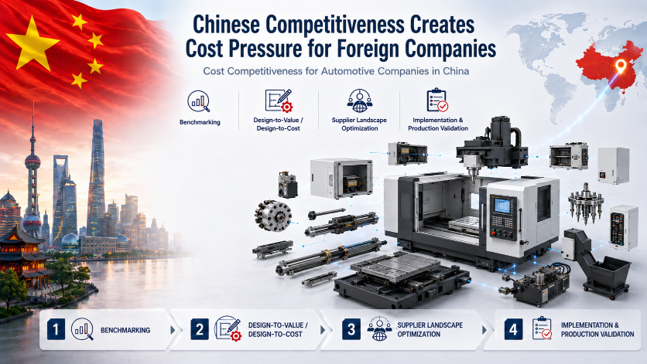
China Cost Optimization 2026 – Balancing competitiveness in a shifting landscape
India’s Industrial Decarbonisation Shift: The Emerging Role of CCUS
