

India's Sunrise Moment: A Macro Overview for Global Business Leaders

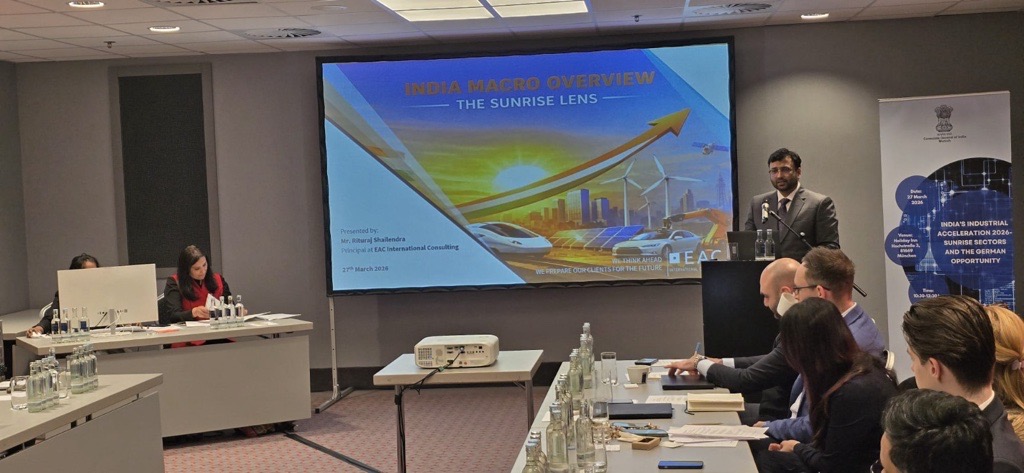
On 27th March 2026, EAC International Consulting, in collaboration with the Consulate General of India in Munich and RÖDL , hosted an invite-only executive roundtable on Indian Sunrise Sectors with a focused lens on Solar PV, Battery, Semiconductor, and Green Hydrogen. The event brought together senior decision makers to deliberate on the evolving opportunity landscape and strategic imperatives it creates for companies operating in, or actively considering, India as an investment destination.
The discussion drew from EAC's India Review 2025 - our annual flagship publication synthesising macro trends, sector-level data, and on-the-ground client intelligence gathered through over three decades of advising European companies across India.
A world fragmenting and India finding its footing
Global trade fragmentation, once a theoretical risk, has become a structural reality. Heightened tensions along critical shipping corridors, elevated freight and insurance costs, and the accelerating decoupling between US-aligned and China-aligned supply chains are compelling companies to rethink not just sourcing, but their entire value chain architecture.
For India, this fragmentation carries an unexpected strategic upside. Its posture of geopolitical neutrality maintaining stable and credible access across US, Europe, and Asia simultaneously positions it as a uniquely viable alternative for manufacturing, sourcing, and market access. Two landmark developments in 2026 have given this thesis renewed commercial urgency: the signing of the EU–India Free Trade Agreement with phased tariff reductions now underway, and a US–India trade deal that has meaningfully improved the bilateral outlook.
For European companies, the implications are nuanced and sector specific. The localisation mandate remains firmly intact and, if anything, has gathered momentum. The strategic question has shifted from whether to engage more deeply with India to how swiftly and with what degree of execution discipline.
"Geopolitical fragmentation creates near-term risks but structurally strengthens India's role for German and Chinese companies." - EAC International Consulting
From boardroom intent to operational execution
India's manufacturing narrative has matured considerably. The global trade realignment has accelerated this transition. Capital is flowing into identified priority sectors - machinery, chemicals, healthcare, and consumer goods - as well as into advanced manufacturing verticals such as semiconductors, electronics, green hydrogen, and batteries. Investor-led momentum is equally visible in automotive, energy transition, and environment-linked industries.
Yet value creation will not be evenly distributed. Our assessments consistently show that what separates winning investments from stalled projects is not policy intent, but execution readiness including regulatory compliance, manufacturing feasibility discipline, location selection, and the right entry model.
"India offers one of the strongest manufacturing platforms globally; however, value creation will be uneven and increasingly shaped by feasibility discipline, partner capability, and execution readiness rather than policy intent alone."
Sunrise Sectors: Where India’s industrial ambition is taking shape
Four sectors sit at the heart of India’s industrial transformation: Semiconductors, Solar PV, Battery, and Green Hydrogen. Each is backed by dedicated policy frameworks, significant capital commitments, and growing domestic as well as export demand. Together, they represent the frontier where India’s structural advantages — scale, cost competitiveness, and policy resolve are most tangibly converting into investable, high-growth opportunities for European companies.
What this means for EU manufacturers
The EU–India FTA is a strategic inflection point - one that demands active reassessment, not passive monitoring. For EU manufacturers, it opens a structured set of decisions across five interconnected dimensions:
Opportunity assessment · Sourcing optimisation · Regional supply chain strategy · M&A and partnerships · Pricing and commercial strategy
Each of these dimensions carries meaningful financial and strategic implications shaped by your sector, product lines, current India footprint, and competitive exposure. We work through these with our clients in a structured, evidence-based manner.
Speak with our team to understand what each of these means for your business specifically.
33 years. Five offices. 100+ team members. 3,500 projects. And we continue to learn, to grow.
EAC International Consulting has been advising European companies on their India journey since 1992. Our engagements span India investment strategy, manufacturing feasibility, M&A target screening, commercial due diligence, and market entry.
What we have observed consistently is the companies that succeed in India are not always those with the largest budgets or the most elaborate plans. They are the ones that approach India with rigour understanding the regulatory landscape, selecting the right location, choosing the right entry model, and building partnerships that genuinely complement their capabilities.
The Sunrise Lens is not optimism for its own sake. It is a disciplined framework for identifying where structural tailwinds are strongest and where focused execution can convert them into durable competitive advantage.
If you would like to explore what India's macro trajectory means for your organisation specifically, we would be glad to arrange a conversation. Connect with: Mr. Rituraj Shailendra & Mr. Anup Barapatre, Principals at EAC International Consulting
Latest
India’s Maritime Transformation: Logistics, Manufacturing, and Indo‑German Collaboration
Why Hyper-Localization is the New Playbook for International Success in China

China Cost Optimization 2026 – Balancing competitiveness in a shifting landscape
India’s Industrial Decarbonisation Shift: The Emerging Role of CCUS
