

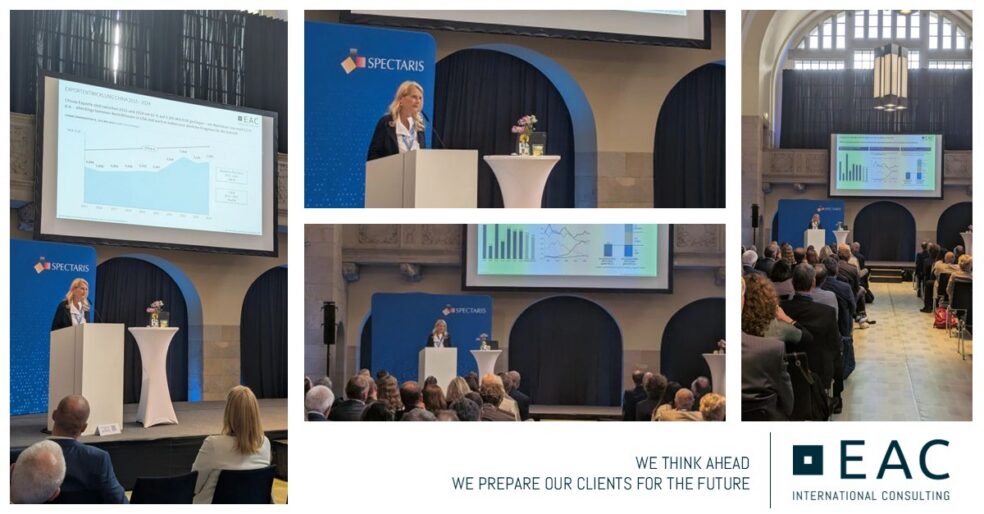
Insights from EAC at the SPECTARIS Future Festival 2026
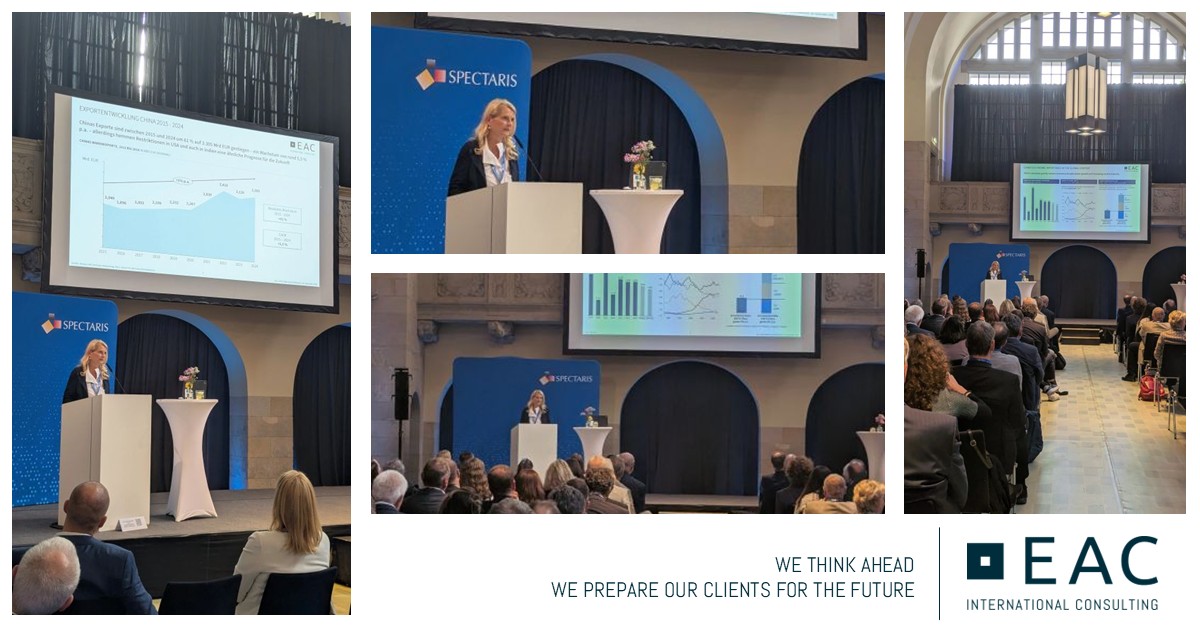
SPECTARIS, the German industry association for optics, photonics, analytical and medical technology, hosted its annual “Zukunftsfestival” in Berlin in September 2026 under the theme "China - Transformation & Paths to Growth."
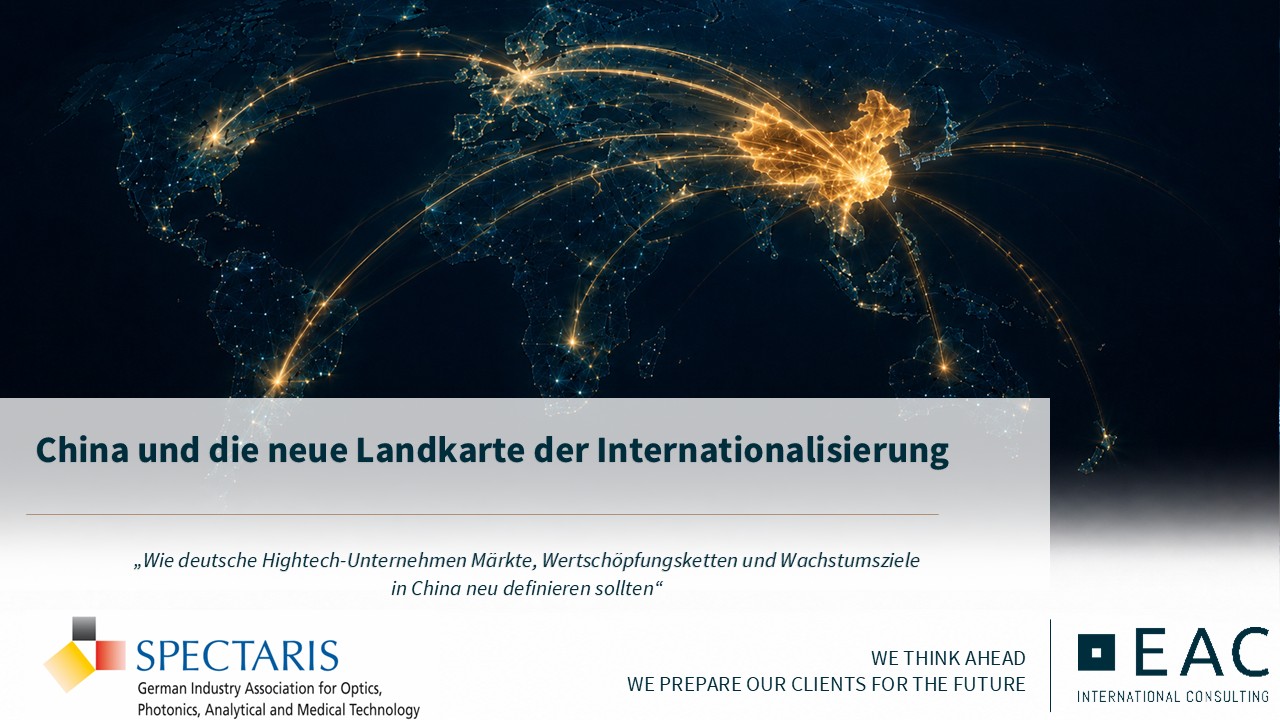
Daniela Bartscher-Herold, founding partner of EAC – Euro Asia Consulting, shared China-insights with the presentation "China and the New Map of Internationalisation: How German High-Tech Companies Should Redefine Markets, Value Chains and Growth Targets."

Why China matters to German High-Tech SMEs
SPECTARIS represents more than 400 SMEs which generate around 65% of their revenue through exports. After the EU, the United States and China are the most important markets for the German Mittelstand. Competition with and within China has intensified markedly.
Drawing on current EAC engagements, Mrs. Bartscher-Herold examined China in four roles:
- As a supplier: China offers speed and cost efficiency. Using it requires local supply chain management that addresses export risks, hidden dependencies in upstream processes and the protection of know-how.
- As a sales market: China shows growing demand in premium and high-tech segments. Localisation requirements and competitive pricing scenarios must be approved at executive board level as part of sales planning.
- As a manufacturing hub: China provides a head start, market access and a foothold in third markets, against risks of know-how outflow, capacity utilisation and fast-changing regulation.
- As a competitor in international markets: China is reshaping the playing field. Chinese exports rose by 61% to EUR 3,305 billion between 2015 and 2024 - about 5.5% per year. In India and ASEAN, SPECTARIS members increasingly meet the same Chinese competitors but India's QCO measures (Quality Control Order) are already showing positive effects.
Two case studies, 2 lessons learned
Two case studies from the presentation showed how fast these roles can shift the competitive balance and how companies can respond. Within only 4 years, an US laser manufacturer lost more than 50% of its Chinese market share to a domestic competitor, which now also supplies to leading German OEMs.
The opposite lesson came from a European medical diagnostics manufacturer, which managed to offset a politically imposed price disadvantage in public procurement through a significantly increased level of localisation in China.
For SPECTARIS members who want to maintain competitiveness through 2030 and beyond need an integrated strategy: shaping the global value chain, learning from the speed and supplier depth of Chinese competitors and preserving their own core strengths. China should be viewed not only as a sales market, but also as a partner, an innovation location and a learning field.
Daniela Bartscher-Herold co-founded EAC in 1994 after several years as a strategy consultant at Roland Berger. Based at EAC Munich, she advises clients on market entry, growth strategy, restructuring, cost optimisation and global supply chain design, working closely with EAC's offices in China, India, Malaysia and the USA.
For any further inquiries, please contact eac@eac-consulting.de
Latest
India’s Maritime Transformation: Logistics, Manufacturing, and Indo‑German Collaboration
Why Hyper-Localization is the New Playbook for International Success in China

China Cost Optimization 2026 – Balancing competitiveness in a shifting landscape
India’s Industrial Decarbonisation Shift: The Emerging Role of CCUS
