

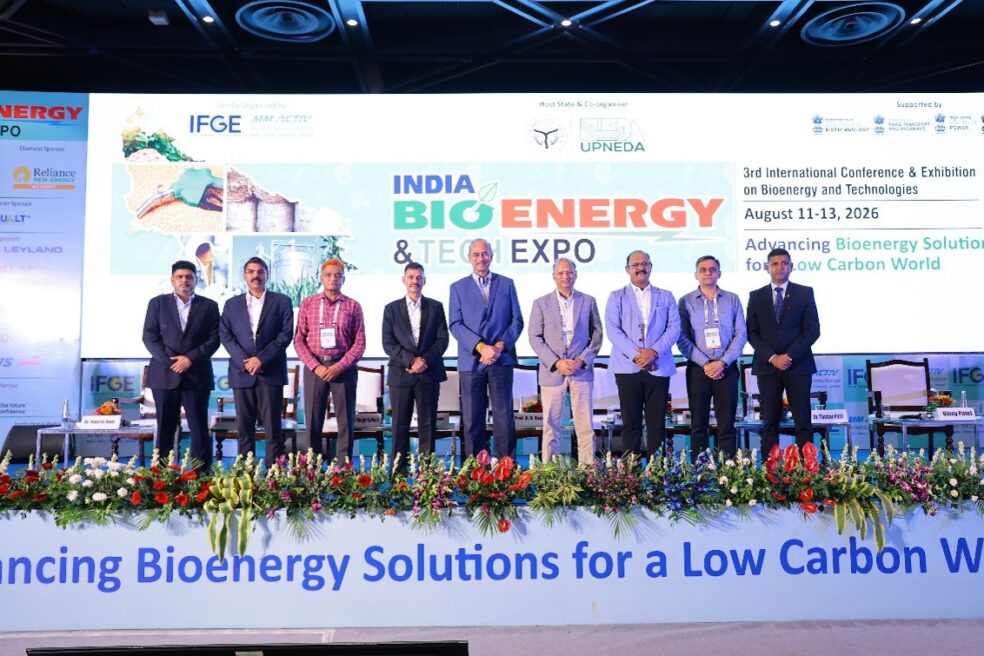
From Policy to Execution: EAC at IBET Expo 2026

Dr. Rajesh Raut, Managing Consultant at EAC International Consulting, moderated the session “Robust Supply Chain and Healthy Farm Circularity in the CBG Sector,” bringing together industry experts from across feedstock aggregation, technology, CBG development and the agricultural ecosystem.
From Feedstock Availability to Accessibility
A key theme of the discussion was the sector's transition from policy readiness and project announcements towards execution, with greater focus now required on making projects commercially viable and operationally resilient.
India has significant feedstock potential across agricultural residues, animal manure and dairy waste, MSW, pressmud and other industrial waste streams. However, availability does not necessarily translate into accessibility. Seasonality, fragmented supply, competing uses, aggregation, storage, logistics, contracting and farmer participation can determine whether feedstock can be delivered reliably and economically to CBG plants.

The discussion highlighted the need to move beyond theoretical biomass assessments towards reliable, commercially viable and operationally resilient feedstock supply chains.
FOM: Building a Second Value Stream
The panel also examined the downstream side of the CBG value chain. FOM already has an established revenue floor through the existing MDA framework, but increasing CBG capacity will create larger volumes that need to be processed, monetised and returned to agriculture.
The government's consideration of a fixed-price regime under GOBARdhan, with detailed provisions awaited, could provide greater flexibility for producers to pursue value from FOM beyond its current carbon-enhancer application.
The opportunity now extends towards productisation, value addition, alternative applications and stronger downstream market linkages, creating the potential for FOM to become a second value stream for CBG projects. However, creating the product is only one part of the equation. Distribution, offtake and farmer adoption will be equally important to establish a commercially viable circular pathway.
Building More Comprehensive State-Level CBG Frameworks
Dr. Rajesh Raut also presented EAC's assessment of the State-level Policy Outlook for CBG in India, highlighting the growing importance of state-level frameworks as the industry moves into execution.

The next phase of CBG development will require state policies to become more comprehensive and differentiated, addressing not only production incentives but also feedstock accessibility, infrastructure, project execution and FOM monetisation.
EAC also highlighted two recent industry reports:
- India CBG State Policy Landscape
- FOM Opportunity: Building a Second Value Stream for CBG
Together, these insights reinforce a broader industry message: India's CBG opportunity will depend not only on adding capacity, but on building the supply chains and circular business models required to make that capacity work reliably at scale.
EAC International Consulting continues to support stakeholders across the CBG value chain through market intelligence, policy assessment, feedstock strategy, project feasibility and FOM opportunity development.
Latest
India’s Maritime Transformation: Logistics, Manufacturing, and Indo‑German Collaboration
Why Hyper-Localization is the New Playbook for International Success in China
China Cost Optimization 2026 – Balancing competitiveness in a shifting landscape
India’s Industrial Decarbonisation Shift: The Emerging Role of CCUS
