

INDIA’S SOLAR MANUFACTURING PIVOT: WHY GLOBAL PLAYERS MUST ACT NOW
India’s Solar Growth Story: From Scale to Manufacturing Sovereignty
India is now the world’s fourth largest renewable energy market and the third largest solar market. Flagship programs such as PM Surya Ghar, Solar Parks and PM KUSUM have driven the rapid expansion from 2.8 GW to 130 GW in a decade. India is now shifting from demand creation to a manufacturing localization strategy aimed at strengthening domestic capability and reducing import reliance.
Figure 1: India Installed Solar Capacity (GW)

India’s Manufacturing Push: Opportunities and Structural Gaps
Government policy has accelerated domestic module and cell capacity with instruments such as Basic Customs Duty, BIS certification, 100% FDI allowance and the 2.4 bln EUR PLI scheme. Despite this momentum, large upstream gaps remain in polysilicon and wafer manufacturing, while advanced cell technologies such as HJT and tandem have limited domestic readiness. Downstream BoP components continue to face reliability and quality constraints, creating whitespace for global suppliers with proven technology and execution depth.
Technology Transitions: India at a Strategic Inflection Point
The global shift toward TOPCon, HJT and perovskite-silicon tandem architectures is redefining competitiveness in solar manufacturing. India’s ecosystem is not yet aligned with these advances, reflecting gaps in precision manufacturing, metallization, high-purity materials and equipment supply. This presents an attractive window for global equipment manufacturers, IP owners and technology leaders looking to establish long-term footprints in India.
Table 1: Technology Transition Matrix

PV Manufacturing & BoP Opportunity
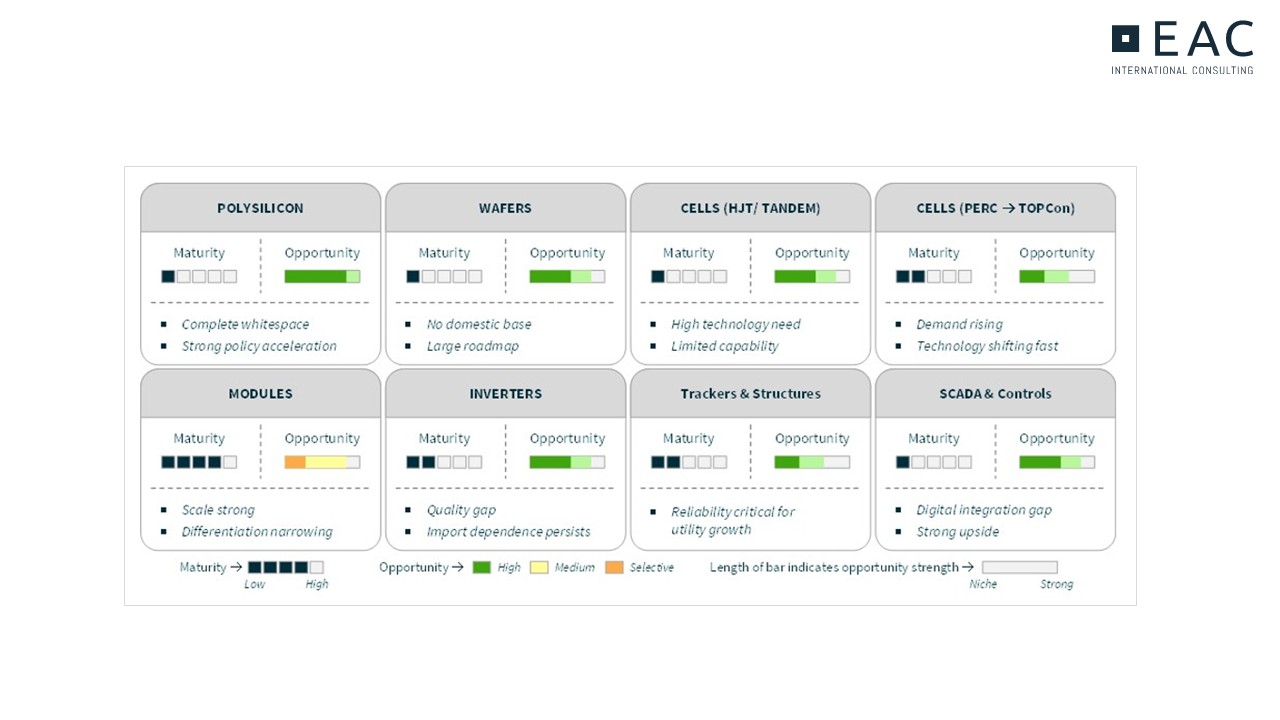
India’s solar supply chain exhibits uneven maturity, creating distinct opportunity clusters across the value chain. Upstream segments such as polysilicon, wafers and advanced cell technologies provide the highest opportunity due to weak domestic capability and strong policy push. Downstream components including inverters, SCADA and storage remain fragmented and offer meaningful whitespace for differentiated global players. The deepest opportunities lie where capability scarcity intersects with policy ambition.
Why a Structured Approach is Essential for Success in India
India offers long-term scale and policy momentum, but market entry requires disciplined execution. Success will depend on precise localization feasibility assessment, clear technology positioning and strong partnership models with EPCs, suppliers and state agencies. Companies that proactively align capability strengths with India’s emerging opportunity clusters will be best positioned to shape the next decade of solar manufacturing leadership.
Sustainable value will come to those who apply analytical discipline, rigorous market sizing, careful technology selection and a strong localization blueprint.
EAC can support at every step in designing and executing this strategy.
For an insightful discussion you may connect to EAC team members Anup Barapatre or Anand Chikte for a consultation on this promising topic.
Latest
India’s Maritime Transformation: Logistics, Manufacturing, and Indo‑German Collaboration

Why Hyper-Localization is the New Playbook for International Success in China

China Cost Optimization 2026 – Balancing competitiveness in a shifting landscape
India’s Industrial Decarbonisation Shift: The Emerging Role of CCUS
