

Webinar Recap: Beyond Tariffs – How German Companies Can Operationalize the EU–India FTA
On 18 June 2026, the Indo‑German Chamber of Commerce (AHK‑Indien/IGCC) and EAC International Consulting co‑hosted a webinar on the strategic implications of the EU–India FTA.
Speakers:
- Rituraj Shailendra, Principal, EAC International Consulting
- Anne Krieckhaus, Managing Director, AHK‑Indien
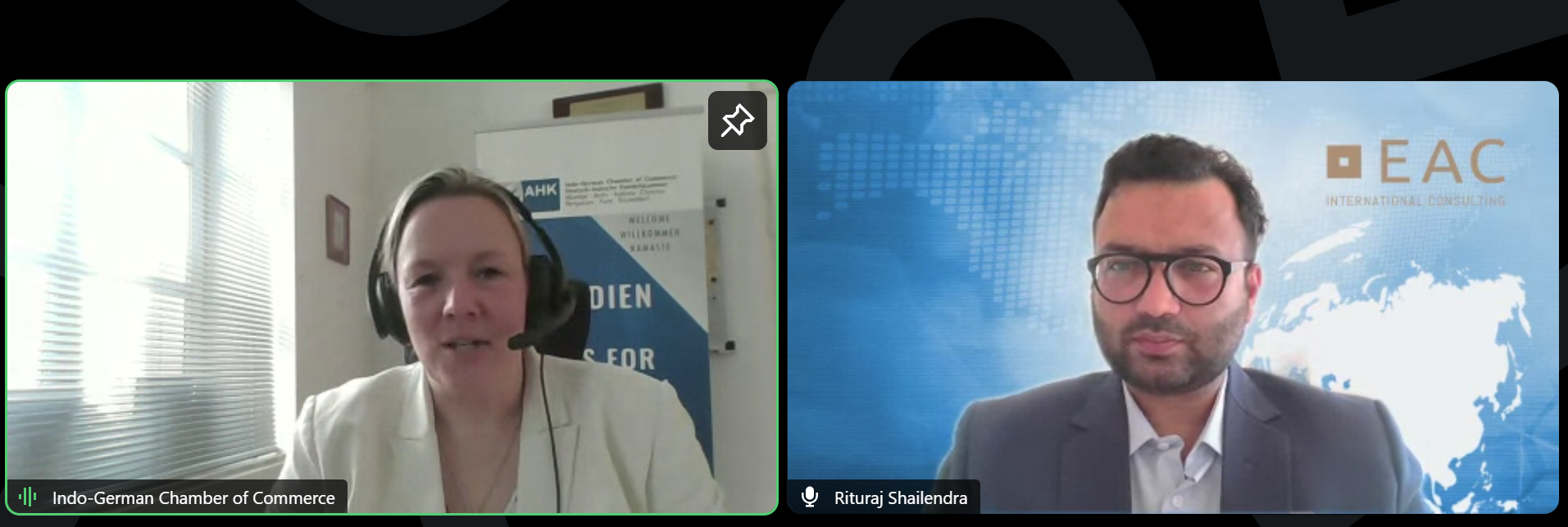
The webinar drew 56 registrations from a diverse mix of German and Indian companies, including DHL, Kalzip, Siemens, Röchling, Planet Biogas, Otto Group, Merck, BASF, and Hellmann, reflecting strong cross‑sector interest in the EU–India FTA and its practical implications for supply chains and market access.
The EU–India FTA, signed in January 2026 after 19 years of negotiations, represents one of the world’s largest future trade corridors — covering 25% of global GDP, 2 billion consumers, and nearly €178 billion in traded goods and services.
While tariff liberalization (e.g. cars 110% → 10%, chemicals 22% → 0%, machinery tariffs up to 44% → 0%) is a headline achievement, the real opportunity lies in operationalizing the agreement across supply chains, sourcing structures, compliance frameworks, and long‑term market positioning.
Key Insights
- India as a strategic anchor: India’s rise into the global top six economies is reshaping operating models. It is evolving from a demand‑driven market into a manufacturing and export hub, supported by policy reforms (PLI, defence indigenisation, logistics upgrades) and execution credibility.
- Macro stability: Stable repo rates (5.4–5.7%), easing inflation, and FDI inflows (~USD 81 bn FY25) confirm India’s resilience and attractiveness for long‑term investors.
- Industrial momentum: Capital goods surged 16% YoY, signalling investment‑led growth and confidence in India’s consumption outlook.
- FTA depth: The agreement influences manufacturing footprints, supplier selection, and localization strategies. Compliance with rules of origin and QCO frameworks is decisive.
- Sectoral winners: Textiles, footwear, chemicals, electronics, machinery, and pharmaceuticals benefit most. Agriculture and steel face pressure; automotive and medical devices remain watchlists.
- German companies: Despite strong trade linkages, German FDI remains underweight (~1%). Closing this gap requires localization, partnerships, and faster execution.
- China+1 diversification: India offers resilience and optionality for supply chains, enabling dual‑sourcing and export expansion.
- Execution readiness: Costs (ESG, CBAM, compliance) will precede benefits. Early movers who define business cases now will capture asymmetric advantages.
Its Implications
- The FTA is not just about tariff relief but about embedding India into global operating models.
- Companies must evaluate manufacturing footprints, supplier qualification, and localization depth to remain competitive.
- The agreement provides a platform for multi‑region exports, positioning India as a resilient hub in a fragmented global economy.
- For German firms, the benchmark is clear: India should contribute ~10% of global business, anything less is underutilization.
This webinar underscored that the EU–India FTA is a catalyst for stronger Indo‑German partnerships, resilient supply chains, and sustainable growth. Future sessions with IGCC Düsseldorf will continue to provide analytics, sector insights, and actionable frameworks for companies navigating this new trade architecture.
For more information, connect with Rituraj Shailendra and Anne Krieckhaus.
Latest
India’s Maritime Transformation: Logistics, Manufacturing, and Indo‑German Collaboration
Why Hyper-Localization is the New Playbook for International Success in China

China Cost Optimization 2026 – Balancing competitiveness in a shifting landscape
India’s Industrial Decarbonisation Shift: The Emerging Role of CCUS
