


“India in Intralogistics - From Cost Advantage to Technology Maturity”
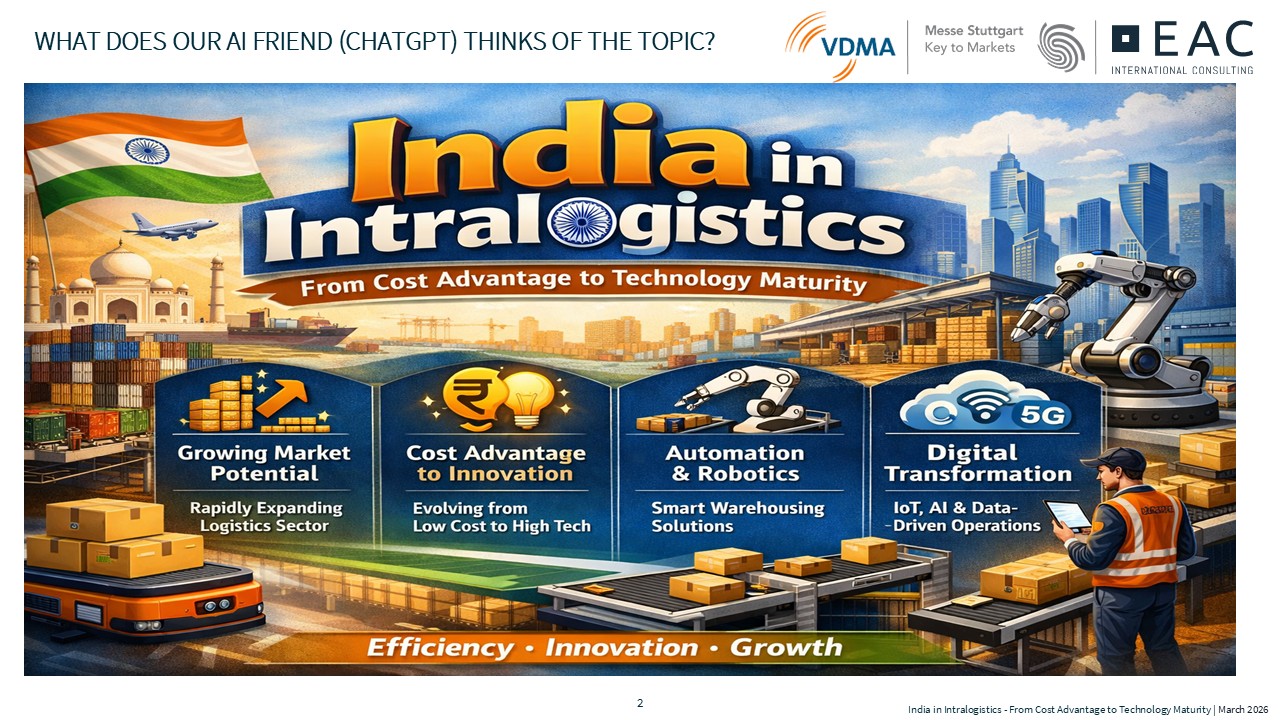
The Economics of "Make in India"
The financial argument for localizing production in India is compelling, particularly when analyzing the unit economics of precision components. A detailed cost-benefit analysis of a Robotics Mechanical Frame reveals that localization can lead to a 31% total BOM reduction. These savings are driven by a 38% lower expenditure on CNC machining, welding, and surface treatment within local ecosystems like the Chennai precision engineering corridor.
Crucially, these cost advantages do not require a sacrifice in quality. Local Tier-1 suppliers are currently achieving ±0.05mm tolerances, meeting the most stringent EU benchmarks. Furthermore, the speed to ROI is remarkable; most firms see a full payback on qualification and setup costs in less than one month once steady-state production is reached.
While Indian demand is surging, critical technology gaps remain that favor established European Intellectual Property. EAC has identified several "missing pieces" in the local ecosystem where EU players can establish a dominant and immediate competitive moat.
The Hardware Frontier in sectors like advanced drive systems and high-precision gearboxes, the market remains heavily import-dependent, representing a significant addressable whitespace for those who localize.
The digital & software horizon beyond hardware, a significant "white space" exists for sophisticated Warehouse Management (WMS) and Execution Systems (WES). As Indian operations scale in complexity, the lack of local pure-play competitors leaves the field open for proven EU platforms. Furthermore, the rapid digitization of Indian material handling fleets is creating a burgeoning SaaS opportunity for predictive maintenance and digital twin solutions, a territory where European software excellence remains the gold standard.
To navigate this landscape, EAC recommends a three-phased maturity model. Firms should begin with Direct Export to generate immediate revenue with zero local investment. As the market footprint grows, the second phase involves Localization, establishing local R&D or assembly to capture PLI incentives and further reduce costs. Ultimately, successful firms transition into using India as a Global Hub, leveraging a high-margin, low-cost base to serve the broader ASEAN, MEA, and APAC markets.
The transition toward an India centric manufacturing strategy is no longer a matter of "if," but "when." By bridging the gap between European technology and Indian industrial scale, OEMs can secure their leadership in the next decade of global logistics.
To discuss your specific market entry strategy, please contact our team: Anup Barapatre and Rituraj Shailendra.
Latest
India’s Maritime Transformation: Logistics, Manufacturing, and Indo‑German Collaboration
Why Hyper-Localization is the New Playbook for International Success in China

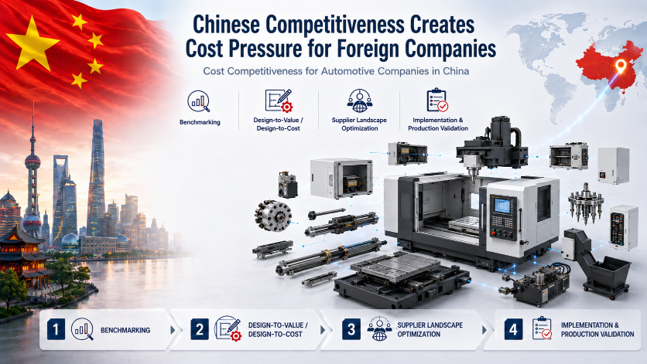
China Cost Optimization 2026 – Balancing competitiveness in a shifting landscape
India’s Industrial Decarbonisation Shift: The Emerging Role of CCUS
