

China Quo Vadis: Strategic Repositioning of a Key Market
The China boom of past decades is over. With approximately 5.0% growth in 2025 and an expected 4.5% in 2026 – hereof estimated 2.0 - 2.5% public-induced investments – economic momentum is normalizing in international comparison. Nevertheless, China remains a systemically important key market. Its market size, industrial depth, and technological advancement remain unique. For many German industrial companies, China continues to be a central source of revenue and innovation.
This shift in market shares is driven primarily by increasing competitive intensity and the growing technological capabilities of local players. In industries such as automotive, solar, and wind power, China has developed substantial technological independence. At the same time, selected high-tech segments continue to offer significant growth opportunities for international companies.
Investment patterns are also changing structurally. Despite declining overall foreign direct investment, German companies continue to commit to the market. The strategic focus is shifting away from capacity expansion and towards technology centres, local R&D, and deeper local value integration. Industrial policy frameworks including the 2025 Investment Catalogue, the 15th Five-Year Plan, and rising localisation requirements set clear and consequential strategic parameters that cannot be overlooked.
Long-term success therefore requires deeper localization, strategic partnerships, and the consistent adaptation of existing business models to an increasingly competitive policy-driven landscape.
Please find the full Executive Briefing available for download here.
Latest
India’s Maritime Transformation: Logistics, Manufacturing, and Indo‑German Collaboration
Why Hyper-Localization is the New Playbook for International Success in China

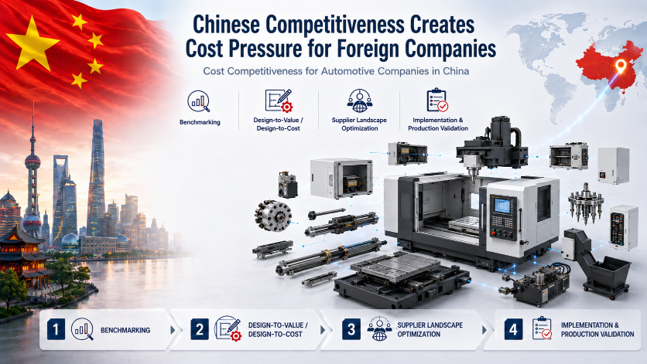
China Cost Optimization 2026 – Balancing competitiveness in a shifting landscape
India’s Industrial Decarbonisation Shift: The Emerging Role of CCUS
