Outsourcing of non-core activities to developing Innovation hubs: The new Shared Services concept in practice To focus on core business competencies without impeding the flow of non-core activities while achieving cost efficiencies, businesses have been setting up shared services centers (SSCs) since 1980s but over the years, the model has evolved to adapt better to changing business requirements. From Shared Services Centers (SSC) to Global Competence Centers (GCC) and Global Business Services (GBS), service delivery model encompassing outsourcing, captive shared services as well as centers of excellence (COEs) for serving various business units have been the guiding pillars to offer centralized …
India and ASEAN – Investment Destinations
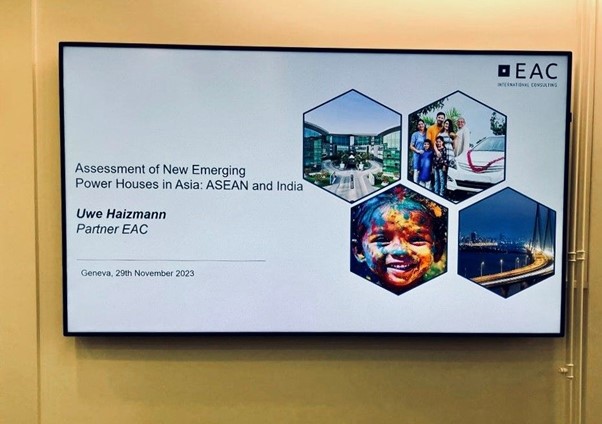
India & ASEAN – Investment Destination Today I had the honor to share my views on India and ASEAN as important investment destinations for foreign and especially Swiss investments. Swiss Foreign Direct Investment (FDI) into ASEAN accounted for > 6bn USD last year making it one of the most important destinations for the Swiss Confederation. Additionally, more than 350 Swiss companies are invested in India of which 50% have substantial manufacturing facilities. With a Trade and Economic Partnership Agreement (TEPA) on the horizon, the momentum for Swiss-Indian investments is thriving. Thanks to the Geneva Chamber of Commerce, Industry and Services (CCIG) – for …
Platform Business Models – Are Investments Justified?

Platform Business Models – Are Investments Justified? Can traditional process-based firms do asset light business? Is there a possibility to get into platform model of business as a replacement or an augmentation to existing source of revenue without increasing the operating cost too much? More than 60% of the Fortune 500 companies employ platform-based business models for their operations (most of them are consumer focused software system based B2C organizations) and the trend has quickly shifted to B2B companies in the recent past who wish to be closer to their final consumers. The issue is of commercialization of the innovation …
Die neue Lokalisierungswelle – warum sich ausländische Firmen ein zweites Standbein in China aufbauen

Die neue Lokalisierungswelle – warum sich deutsche Firmen ein ’second home‘ in China aufbauen Angetrieben von der Nachfrage aus der EU und den USA verzeichnete China seinen bisher größten Handelsüberschuss. Und fast alle großen Konzerne – von DuPont und Airbus bis hin zu Tesla und Lego – haben inzwischen Innovations- oder R&D-Zentren in China eingerichtet. Marco Beba, Managing Consultant bei EAC Shanghai, erklärt, warum es für ausländische Unternehmen immer wichtiger wird, die Präsenz in China zu erhöhen. In seinem Beitrag für die Frühjahrsausgabe 2022 des „German Chamber Ticker“ analysiert China Experte Marco Beba die wichtigsten Gründe, warum ausländische Unternehmen die …
The new wave of localization – why foreign companies build a ’second home‘ in China
The new wave of localization – why many foreign companies build a ’second home‘ in China Pushed by demand from the EU and US, China recorded its biggest trade surplus to date. And almost all major corporations – from DuPont and Airbus to Tesla and Lego – have meanwhile set up innovation or R&D centers in China. Marco Beba, Managing Consultant at EAC Shanghai, explains why it is increasingly important for foreign companies to buid a ‘second home’ in China. In his article for the Spring 2022 issue of „German Chamber Ticker” Marco Beba analyses the major reasons why foreign …
China FDI Boom in 2021

FDI into China reaches new highs in 2021: What does it mean? How is China performing in FDI inflows? Global Foreign Direct Investment fell sharply by 32% to 1031 billion USD in 2020, according to the OECD. However, China’s FDI inflows bucked the trend and rose to 212 billion USD by increasing 14%, surpassing the US to become the world’s largest recipient of foreign capital. According to data released by the Ministry of Commerce in China, the actual use of foreign capital in the country hit a record of 173.5 billion USD in 2021 – increasing by 20% YoY. We …
EAC Webinar “China Battery Outbound Investment”

EAC Webinar “China Battery Outbound Investment” In cooperation with China Industrial Association of Power Sources (CIAPS), supervised by the Ministry of Industry and Information Technology of P.R. China (MIIT), EAC conducted a webinar on “China Battery Outbound Investment” on July 10th2020. Over 300 participates from battery manufacturers, battery raw material manufacturers, equipment suppliers, service providers and financial institutes participated.Besides EAC experts from CATL, TÜV SÜD and Exyte participated as speakers in the Webinar to support Chinese companies along the EV battery value chain to investing in overseas markets. Targets of the webinar have been: – How can the Chinese battery …
Digitalization as the new “Magic Weapon” for the international MICE Industry?

Digitalization as the new “Magic Weapon” for the international MICE Industry? With the outbreak of COVID-19 in early 2020, exhibition industry seems to press pause globally. Conservative statistics show that already over 2,400 fairs and exhibitions worldwide have been cancelled or postponed due to the Coronavirus only as of middle of April 2020. UFI estimated that 88.2 billion USD of total economic output related to the exhibition industry will not be generated by the end of Q2.Nevertheless, since the outbreak, China has not only undertaken effective measures to fight with the spread of the pandemic, but also shows positive signals …
MICE-Industrie – die Erweiterung der Veranstaltungskapazitäten ist in China auf dem Vormarsch

MICE-Industrie – die Erweiterung der Veranstaltungskapazitäten ist in China auf dem Vormarsch Das MICE-Geschäft wird strukturelle Veränderungen erfahren, die durch die globale Pandemie ausgelöst werden – Digitalisierung wird ein grundlegendes Element in den Strategien der Organisatoren werden. Internationale Messeveranstalter müssen sich darüber im Klaren sein, dass sich Chinas Messelandschaft drastischen Veränderungen unterzieht.Herausgefordert durch eine globale Pandemie seit Anfang des Jahres 2020, war die globale MICE-Industrie gezwungen, eine Strategie zu entwickeln und Notfallpläne zu erstellen, um die negativen Auswirkungen der Industrieabschaltung auszugleichen. Nichtsdestotrotz hat sich die Situation in China in den letzten Wochen deutlich verbessert, da nach und nach mehr Beschränkungen …